
Marshall Rosenberg, Ph.D.
Our Founder
"What I want in my life is compassion, a flow between myself and others based on a mutual giving from the heart"
"What I want in my life is compassion, a flow between myself and others based on a mutual giving from the heart"
Marshall B. Rosenberg, Ph.D. (1934-2015) founded the Center for Nonviolent Communication in 1984 and served as the Director of Educational Services until his retirement in 2011.
Growing up in an inner–city neighborhood in Detroit, Michigan (U.S.), Dr. Rosenberg was confronted daily with various forms of violence. Wanting to explore the causes of violence and what could be done to reduce it, he studied psychology and received his Ph.D. in Clinical Psychology from the University of Wisconsin in 1961. In 1966, he was awarded diplomat status in clinical psychology from the American Board of Examiners in Professional Psychology.
Nonviolent Communication training evolved from Dr. Rosenberg’s quest to find a way of rapidly disseminating much-needed peacemaking skills. The Center for Nonviolent Communication emerged out of work he was doing with civil rights activists in the early 1960s. During this period he also mediated between rioting students and college administrators and worked to peacefully desegregate public schools in long-segregated regions.
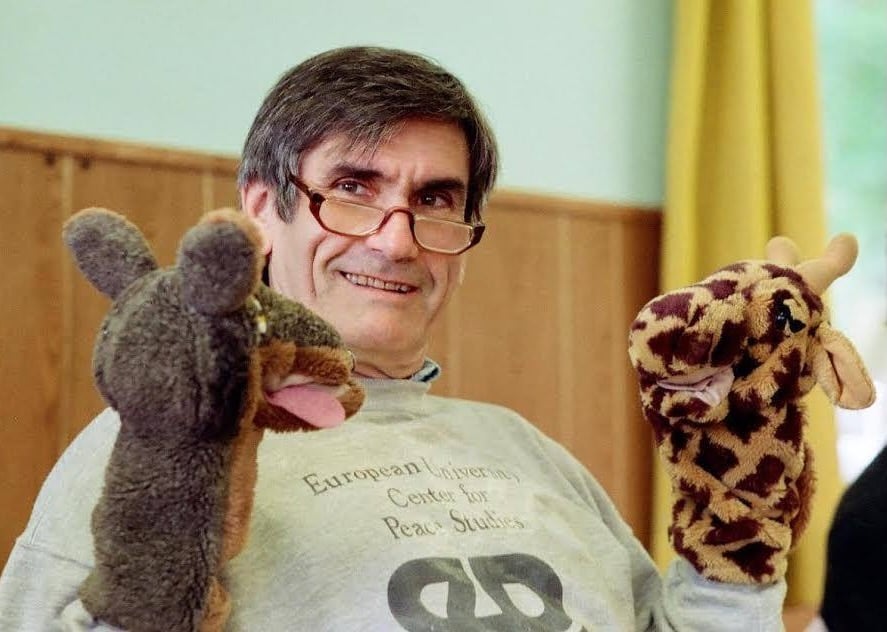
Since the inception of the Center for Nonviolent Communication in 1984, Nonviolent Communication has come to be regarded as a powerful tool for peacefully resolving differences at personal, professional, and political levels. Until his retirement in 2011, Dr. Rosenberg provided Nonviolent Communication training in more than 60 countries. He worked with such groups as educators, managers, mental health and health care providers, lawyers, military officers, prisoners, police and prison officials, clergy, government officials, and individual families. He has been active in war-torn areas and economically disadvantaged countries, offering Nonviolent Communication training to promote reconciliation and peaceful resolution of differences.
Worldwide reactions have been inspiring. Evaluations indicate that this training vastly strengthens the ability to connect compassionately with oneself and others, as well as to resolve differences peacefully. Reports also indicate that the benefit of the training is not only stable over time, but actually increases. In 2006, Marshall received the Bridge of Peace Nonviolence Award.